
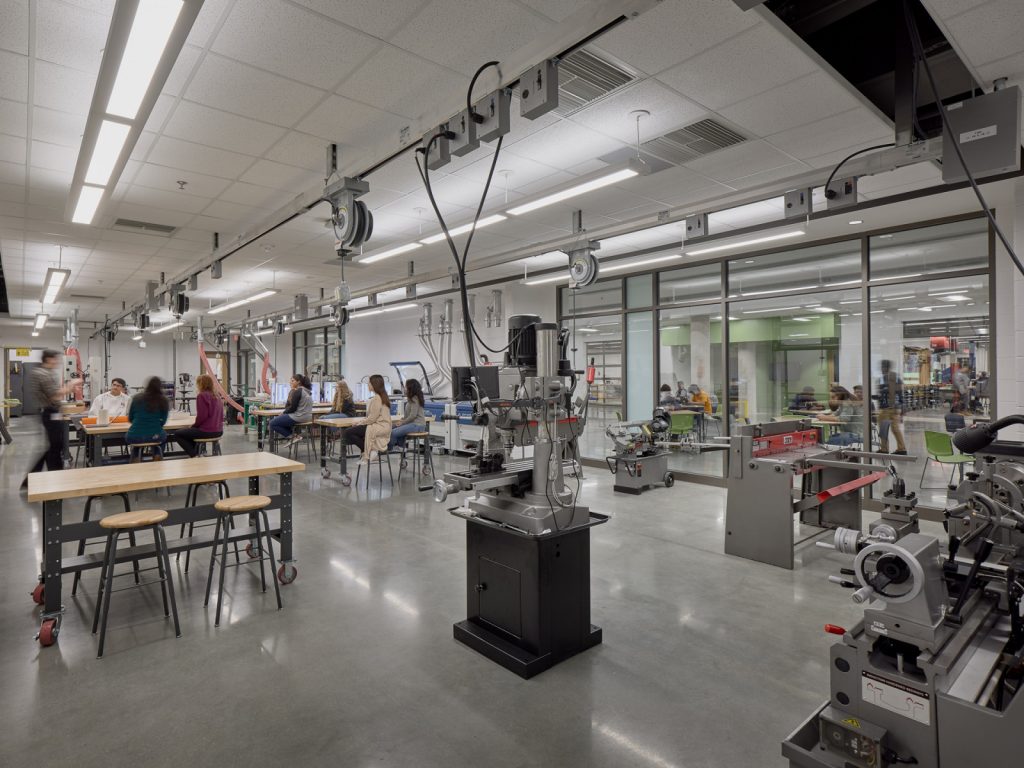
Your child got into the Academy of Science. The excitement is real, the acceptance letter is on the fridge, and now a new question takes center stage: what is freshman year actually going to be like? For families who have only experienced standard LCPS coursework, the AOS curriculum can feel like stepping into unfamiliar territory. The course names do not match anything on the typical high school course catalog. The structure is different. The expectations are different. And the pace can catch new students off guard if they are not prepared for it.
This guide breaks down what your child's first year at AOS actually looks like — how the integrated curriculum works, what the daily schedule involves, how grades translate to GPA, and how the freshman year sets the foundation for the independent research that defines the AOS experience in junior and senior year.
Not Your Typical Science Class
At a standard Loudoun County high school, a freshman typically takes Biology as their first science course. It is a standalone subject. The textbook covers biology. The labs are biology labs. The tests are biology tests. If the student is also taking Algebra I or Geometry, those two courses exist in completely separate silos — the math teacher does not reference biology, and the biology teacher does not reference math in any meaningful, integrated way.
AOS does not work like this. The Academy of Science uses integrated math and science courses that are unique to the program. These are not standard LCPS courses offered under a different name. They are custom-designed curricula that weave together concepts from multiple scientific disciplines alongside advanced mathematical reasoning. A single unit of study might require students to apply algebraic modeling to a scientific dataset, then use that analysis to draw conclusions that connect to broader scientific principles.
This approach reflects how science actually works in the real world. Professional researchers do not think in terms of "this is a biology problem" or "this is a math problem." They think in terms of "this is a problem," and they pull from whatever tools and disciplines are needed to solve it. AOS trains students to think the same way from day one.
For students coming from middle school, where subjects are neatly compartmentalized, this can be a significant mental shift. The student who excelled in 8th-grade science because they were great at memorizing vocabulary and diagrams may find that AOS demands a fundamentally different skill set. The emphasis is on reasoning, connecting ideas across disciplines, and solving problems that do not have a single clear answer.
What "Integrated" Actually Means in Practice
The word "integrated" appears in nearly every description of AOS, but families often have a hard time picturing what it means on a day-to-day basis. Here is the practical reality.
In a traditional high school, a student might take five or six completely separate classes: English, math, science, social studies, a language, and an elective. Each has its own teacher, its own textbook, its own assignments, and its own grading rubric. They do not overlap.
At AOS, the math and science coursework is designed as a unified experience. Students typically encounter problems and projects that require them to move fluidly between mathematical analysis and scientific investigation. A lab assignment might require statistical analysis. A math problem might be contextualized within an experimental scenario. The goal is not just to learn content but to develop the ability to apply knowledge across boundaries.
This integration also means that the pace can feel different from what students are used to. In a standard biology class, a student might spend three weeks on a single chapter about cellular biology before moving to genetics. In an integrated AOS course, the progression is often driven by the complexity of the problems being explored rather than by chapter divisions in a textbook. Students may work on a multi-week investigation that touches on principles from physics, mathematics, and data analysis simultaneously.
The result is a learning experience that feels more like working in a lab than sitting in a lecture hall. Students are expected to be active problem-solvers, not passive note-takers. They work through challenges, make mistakes, revise their approaches, and develop the kind of intellectual resilience that serves them well not just at AOS but in college and beyond.
The Split-School Schedule
One of the most distinctive features of the AOS experience is the alternating-day schedule. Students attend AOS on A-Days and return to their home high school on B-Days. This is not optional or flexible — it is the structural foundation of how the program works.
On A-Days at AOS, students are immersed in the integrated math and science curriculum. This is where the specialized, research-oriented coursework happens. The environment is focused, the class sizes tend to be smaller, and the student body is entirely composed of students who went through the same competitive admissions process.
On B-Days at their home school, students take the courses that AOS does not cover: English, social studies, world languages, and electives. These are standard LCPS courses with the same teachers and classmates as any other student at that school. Your child is still a full member of their home school community — they participate in sports, clubs, and social activities there.
For freshman students, managing this split schedule is often the biggest logistical adjustment. It requires a level of organization and time management that most 14-year-olds have not needed before. Assignments from AOS do not pause on B-Days, and home school work does not pause on A-Days. Students need to track due dates, plan ahead, and communicate with teachers at two different schools.
Parents often find it helpful to establish clear organizational systems before the school year begins — whether that means a shared digital calendar, a physical planner, or regular check-ins about upcoming deadlines. The students who struggle most in the first semester are rarely the ones who lack intellectual ability. They are the ones who have not yet developed the organizational habits to manage two academic environments simultaneously.
The Adjustment Period Is Real
We are going to be straightforward about this: almost every AOS freshman goes through an adjustment period. The students who enter AOS were, in most cases, at or near the top of their middle school classes. Many of them are accustomed to getting A's without having to exert sustained effort. AOS changes that dynamic.
The coursework is genuinely challenging. The integrated approach means students cannot rely on memorization alone. They need to understand concepts deeply enough to apply them in unfamiliar contexts. For a student who has coasted on a strong memory and good test-taking habits, this can feel like running into a wall for the first time.
This is normal. It is, in fact, by design. AOS is preparing students for the kind of rigorous, independent research they will conduct in their junior and senior years. That research requires the ability to work through ambiguity, handle setbacks, and persist through problems that do not have obvious solutions. The freshman-year curriculum builds these muscles deliberately.
What does the adjustment look like in practice? Some students see their grades dip in the first quarter compared to what they were earning in middle school. Some feel overwhelmed by the volume of work or the pace of instruction. Some struggle with the split schedule and forget assignments or miss deadlines. These are common experiences, not red flags.
The students who thrive are the ones who respond to the challenge by developing new strategies rather than retreating into frustration. They ask questions in class. They form study groups with classmates. They seek help from teachers early rather than waiting until they are significantly behind. And they learn to separate their identity from their grades — understanding that a B in an AOS integrated course represents a level of achievement that often exceeds an A in a standard course.
GPA Weight and Transcripts
One of the most common questions from AOS families — and one that often comes up during admissions season — is how AOS courses affect GPA. The answer is reassuring.
AOS courses carry GPA weight that is calculated into the student's home-school GPA. Honors-level AOS courses receive a 0.5 weight, and AP-level AOS courses receive a 1.0 weight. This is the same weighting system used for honors and AP courses at any LCPS high school. A student taking a weighted AOS course receives the same GPA boost they would get from taking an honors or AP course at their home school.
This matters for class rank, for college applications, and for the student's overall transcript. AOS courses are not some separate, unweighted academic sidetrack. They are fully integrated into the LCPS GPA system and appear on the student's official transcript alongside their home-school courses.
For families thinking ahead to college admissions, this is worth emphasizing. College admissions officers at competitive universities are familiar with the Academies of Loudoun. Seeing AOS courses on a transcript signals that a student has pursued the most rigorous science and math curriculum available in Loudoun County. The GPA weight ensures that this rigor is reflected in the numbers, not just in the course titles.
Building Toward Research
Everything a freshman does at AOS is, in a sense, preparation for what comes in Years 3 and 4: independent original research. This is the capstone of the AOS experience, and it is what truly distinguishes the program from even the most rigorous standard high school science offerings.
During their junior and senior years, AOS students identify a research question, design a methodology, collect and analyze data, and present their findings. This research is often conducted in partnership with university or professional laboratories. It mirrors the kind of work that graduate students do, compressed into a high school timeline.
The freshman and sophomore integrated courses build the foundation for this. Students are developing the mathematical tools they will need to analyze research data. They are learning to think scientifically — forming hypotheses, designing experiments, interpreting results, and revising conclusions based on evidence. They are practicing the kind of writing and communication skills that research presentation demands.
If you want a deeper look at how the research phase works, we have written a detailed guide to the junior/senior capstone research project. But for now, the key takeaway is this: the freshman curriculum is not just a set of hard classes for the sake of being hard. Every element serves a purpose, and that purpose becomes clear when students step into the research lab two years later.
For families comparing AOS to other elite STEM programs, the research component is a critical differentiator. Programs like TJHSST also emphasize independent research, but the structural differences between a full-time standalone school and a half-time academy create different dynamics. AOS students split their time between two schools and two very different academic environments, which requires a particular kind of discipline and adaptability that the freshman year helps to build.
FAQs
Are AOS freshman courses harder than honors courses at a regular high school?
AOS integrated courses are not simply harder versions of standard courses — they are structurally different. Rather than covering biology, chemistry, or physics as separate subjects, AOS weaves these disciplines together with advanced math. The difficulty comes from the depth of critical thinking required, not from an increased volume of memorization. Most students find the work more intellectually demanding but also more engaging than what they experienced in middle school.
Do AOS courses count toward my child's GPA at their home school?
Yes. AOS courses carry GPA weight that is calculated into the student's home-school GPA. Honors-level AOS courses receive a 0.5 weight, and AP-level AOS courses receive a 1.0 weight — the same as honors and AP courses at any LCPS school. These courses appear on the student's official transcript.
What subjects does my child take at their home school vs. at AOS?
Students attend AOS on A-Days for their integrated math and science coursework. On B-Days, they attend their home school for English, social studies, world languages, and electives. The split is structural — AOS handles the STEM side, and the home school handles everything else. Your child remains a full member of their home school for sports, clubs, and social activities.
How should my child prepare for the transition from middle school to AOS?
The best preparation is building strong habits in critical thinking, time management, and independent learning. Students who succeed at AOS are comfortable working through problems they have not seen before and managing a split-school schedule. Strengthening math foundations and scientific reasoning skills before freshman year helps ease the transition. For families preparing for the ACL admissions process, the skills you build for the STEM test — flexible reasoning, spatial thinking, scientific analysis — are the same skills that serve students well once they arrive.
Preparing for ACL Admissions?
The critical thinking and scientific reasoning skills that matter at AOS are the same ones tested during admissions. Our prep programs build exactly those foundations — so your child arrives at AOS ready to thrive, not just survive.
Compare Programs