
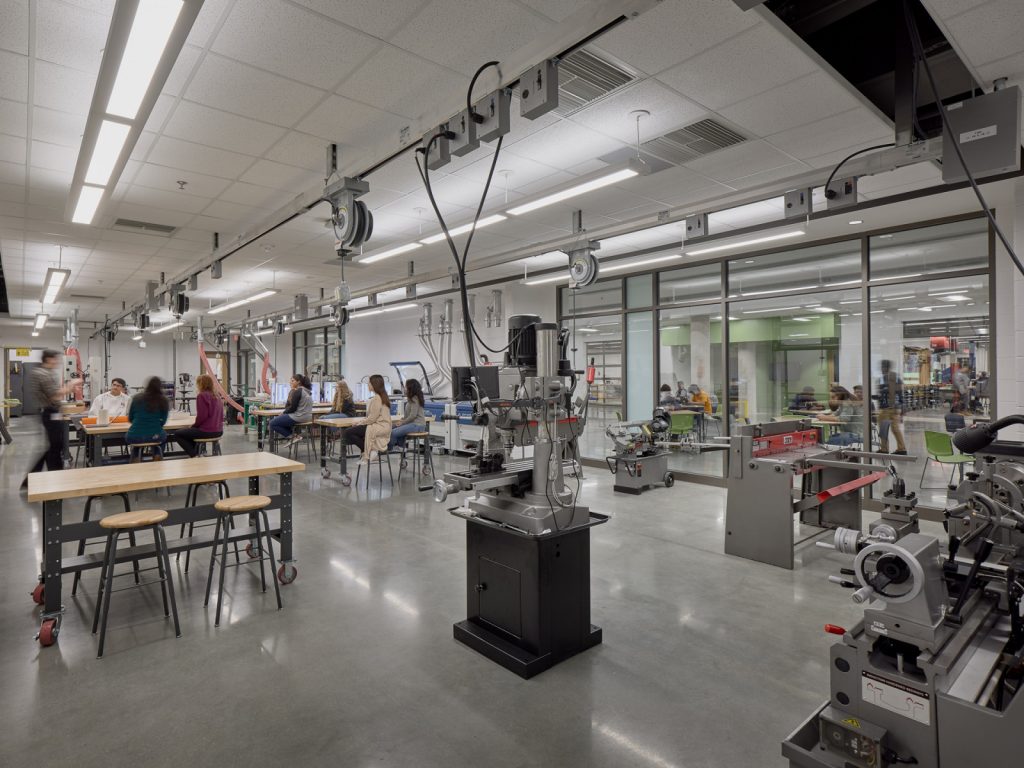
The official AET page organizes the four-year program around Engineering, Information Technology, and entrepreneurship combinations, but “three tracks” is too simple. It publishes a four-year Engineering pathway, a four-year Information Technology pathway, Entrepreneurship plus Engineering, and Entrepreneurship plus IT. Families should compare those actual options instead of treating Entrepreneurship as a completely separate third sequence.
AET also publishes separate two-year Advanced AET options in Engineering and Information Technology for later entry. Those are not interchangeable with the four-year freshman-entry pathways, and their admissions criteria should be checked in the active winter-cycle materials.
Choose the work, not the label
Ask which recurring tasks a student wants to practice: engineering design, computer-science and information-technology research, or STEM-focused business and marketing planning alongside Engineering or IT.
How the current AET page describes the options
| Published option | Official emphasis | Boundary |
|---|---|---|
| AET Engineering, four years | Engineering and the engineering design process | The current course table controls the sequence and credit details. |
| AET Information Technology, four years | Computer science, information technologies, and research projects | The page does not promise a fixed programming-language list. |
| Entrepreneurship plus Engineering, four years | STEM business and marketing plans with Engineering coursework | The page does not promise that every plan becomes a launched company. |
| Entrepreneurship plus IT, four years | STEM business and marketing plans with IT coursework | The page does not promise revenue, investment, or a specific pitch audience. |
| Advanced AET Engineering or IT, two years | Later-entry Engineering or IT study | Use the current winter admissions criteria and course outline. |
Course titles, credits, designations, and sequences can change. The official AET page and LCPS course resources should be treated as the live record, not a copied table in a third-party article.
What the official page says students do
The AET page says Engineering students complete multiple engineering projects. It says IT students design, develop, and conduct multiple research projects. For the entrepreneurship options, it says students develop multiple STEM-focused business and marketing plans.
Those descriptions are meaningful, but they do not identify a guaranteed programming language, hardware platform, company launch, internship, competition, certification, or college result. A student may encounter specific tools or projects in a particular course. Families should verify those details with the current course description and program staff.
A better way to compare the pathways
- Read the current course table together. Highlight the work that sounds energizing and the work that sounds draining.
- Separate subject interest from task preference. Liking technology does not automatically mean enjoying long debugging sessions or research documentation.
- Look at the full sequence. Do not choose from the first course name alone.
- Ask about the combined entrepreneurship options. Confirm whether the student prefers the Engineering or IT side of the combination.
- Plan with the home school. AET students also complete requirements at their home high school.
We often tell families to listen for verbs. Does the student want to design, test, model, debug, research, explain, plan, or market? Verbs reveal more than prestige language.
Questions to verify before ranking a pathway
- Which four-year or Advanced AET option is the student eligible to apply for?
- What exact sequence and course designations apply to this cohort?
- Which projects are required, and which examples are only past student work?
- Which software, equipment, or materials are current?
- How does the option fit the student's home-high-school graduation plan?
- Can the pathway choice be changed after the application window closes?
Pathway choice matters during the application window
The ACL admissions FAQ says AET pathway choices may be changed only while the application window is open. Applicants are not guaranteed their first pathway choice and may receive a second or third choice.
AET pathway FAQs
Does AET have three completely separate tracks?
The official page is more specific: it publishes Engineering, IT, Entrepreneurship plus Engineering, and Entrepreneurship plus IT as four-year options, plus separate two-year Advanced AET Engineering and IT options.
Which programming languages does AET guarantee?
The current public AET page does not publish a guaranteed language list for every cohort. Check current course descriptions and ask program staff about the tools used in a specific course.
Do Entrepreneurship students launch real businesses?
The official page says students develop multiple STEM-focused business and marketing plans. It does not promise that every student launches a company, earns revenue, or pitches to a particular outside audience.
Can an applicant change an AET pathway after the deadline?
The ACL admissions FAQ says pathway choices may be changed only while the application window is open. Recheck the current cycle instructions before submitting.
Keep reading
- Compare AOS and AET by learning model
- Plan around the ACL A/B schedule
- Compare all three ACL programs
- Review the ACL admissions overview
Source note
This guide was checked against the current official AET page, ACL academics page, ACL admissions FAQ, and LCPS CTE curriculum page. Those sources support the published pathway names, program lengths, general project descriptions, and pathway-choice boundary. They do not support a guaranteed programming-language list, equipment list, launched business, revenue, internship, credential, competition, or college outcome. AcademiesPrep by EduAvenues is independent and is not endorsed or sponsored by the Academies of Loudoun or Loudoun County Public Schools.
Official sources reviewed:
- Academy of Engineering and Technology program page
- Academies of Loudoun academics
- Academies of Loudoun admissions FAQ
- LCPS Career and Technical Education curriculum
Fact-checked July 17, 2026. Families should verify current LCPS documents and student-specific guidance.